
Even tiny grins need some TLC! Set your baby’s smile up for a lifetime of thriving oral health with our specialized infant care.

The American Academy of Pediatric Dentistry recommends a first dental visit by a child's first birthday, or within six months of the first tooth appearing. That surprises most parents, who reasonably assume there is nothing to examine yet. There is: how the teeth are erupting, whether the bite is developing evenly, whether the frenulum is restricting movement, and whether early decay has already started on surfaces that are easy to miss at home.
The other half of that first visit is you. Infant appointments are largely a conversation — how to clean teeth that have just arrived, what a bottle at bedtime does over months, when a pacifier stops being harmless, what teething actually looks like and what it does not. Parents who get that guidance at twelve months rarely need the treatment appointments that parents who start at four often do.
Nothing about it resembles an adult cleaning. Your baby usually sits on your lap in a knee-to-knee position, facing you, with the dentist supporting their head, so the person your child is most attached to is the person holding them the whole time. The exam takes a few minutes: a look at the erupted teeth, gums, tongue and the tissue under it, a gentle wipe or polish of the teeth if they are ready for it, and a fluoride varnish if it is appropriate for your child's age and risk. Some babies protest. That is normal, it does not mean the visit went badly, and it is far easier at one than at three.
The most common cause of early childhood decay is not candy — it is milk, formula or juice sitting on teeth overnight. A bottle in the crib gives bacteria hours of undisturbed sugar on the upper front teeth, which is why those teeth are so often the first to break down. Water at bedtime, wiping the gums after night feeds, and moving to a cup around the first birthday prevent more dentistry than anything we do in the chair.
Teething is the other question we field constantly. Sore, swollen gums, extra drool, chewing on everything and disturbed sleep are all normal; a high fever is not, and is worth a call to your pediatrician rather than being written off as teeth. Chilled rings, a clean cold washcloth and firm gum pressure help. Numbing gels containing benzocaine are not recommended for infants, and we would rather you ask us than experiment with something from a shelf.
An infant exam also covers things parents do not associate with a dentist: whether tongue movement is restricted enough to affect feeding, which may lead to a frenectomy consultation; how the upper and lower jaws are meeting, which is the earliest signal of the issues that interceptive orthodontics addresses years later; and whether the eruption sequence is on schedule. Catching those early does not mean treating them early. Usually it means watching them on purpose instead of by accident.
After the first visit, most children settle into cleanings and exams every six months. The clinical value of that is real, but the behavioural value is bigger: a child who has been coming since before they can remember treats the dental office as an ordinary place. They are the children who sail through a filling at seven, and they are the reason we push so hard on that first-birthday visit.
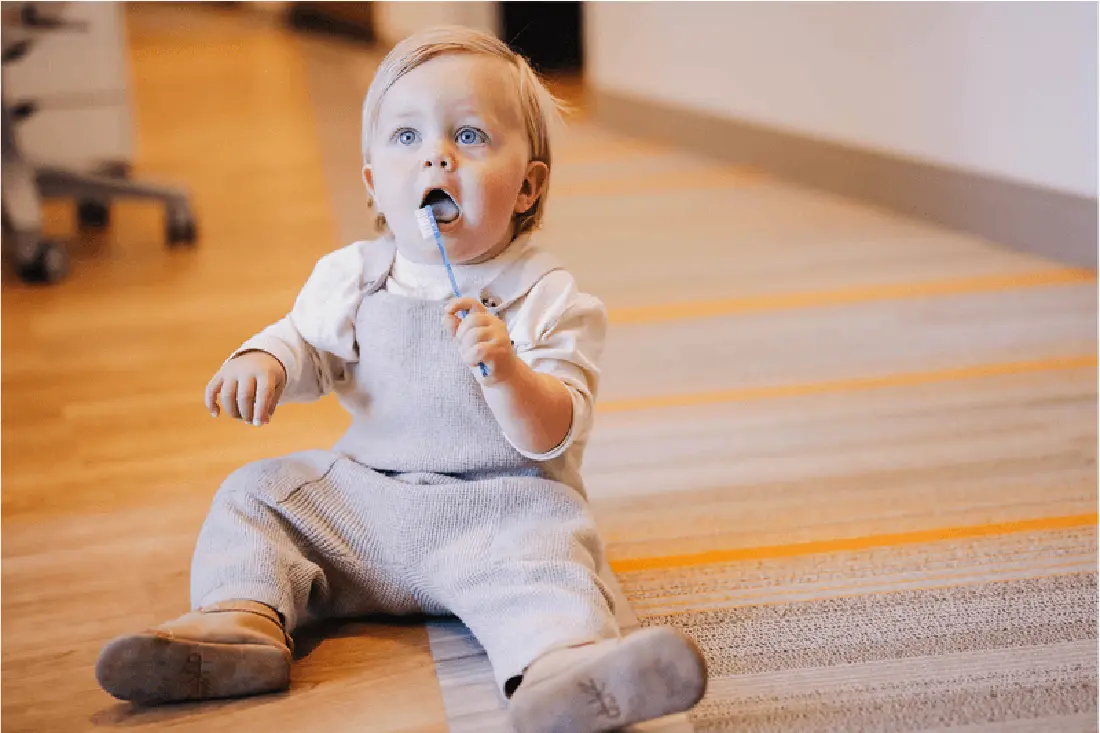

Your baby’s teeth started to develop before they were born.
This is the differentiator paragraph copy. This is the differentiator paragraph copy. This is the differentiator paragraph copy. This is the differentiator paragraph copy.

Complimentary first visit
For children under age 3
Set your little one's smile up for success with a complimentary visit!
See real patient success stories.
Early decay, restricted tongue movement and uneven bite development are all easier to manage when they are found at one year old rather than at four.
Most early childhood cavities trace back to bottles, night feeds and cleaning routines — all of which are fixable with a conversation before the damage starts.
Children who have been visiting since infancy grow up treating dental appointments as routine, which makes every future visit easier.

Your baby stays in your arms in a knee-to-knee position while your pediatric dentist examines the teeth, gums and tongue — usually a matter of minutes.
We check eruption, early decay, the tissue under the tongue and how the jaws are meeting, and gently clean the teeth if they are ready for it.
You leave with specific guidance on cleaning, bottles, teething and diet, and a recall interval based on your child's own risk.

By the first birthday, or within six months of the first tooth appearing — whichever comes first. That is the American Academy of Pediatric Dentistry's recommendation, and it holds even when everything looks perfect to you, because the point of the visit is as much prevention guidance as examination.
Yes. Baby teeth get cavities, cavities cause pain and infection, and they hold the positions that adult teeth follow when they erupt. Start with a soft cloth or infant brush and water, and ask us about toothpaste and how much to use for your child's age at the first visit.
It is the single most common cause of early childhood decay we see. Milk, formula and juice pool around the upper front teeth for hours while your child sleeps, and bacteria have all night to work. Water in the crib is fine; anything with sugar in it is not, and moving to a cup around age one helps.
Then your baby is behaving like a baby, and the exam still gets done. Crying actually opens the mouth, and these visits are short by design. Nobody here is judging your child or you — we would far rather see an unhappy one-year-old than a frightened four-year-old with a mouthful of decay.


.webp)
.webp)
.webp)
